
ZX Spectrum Neo is a ZX Spectrum built today, out of parts you can still buy, and it behaves like the original because underneath it is the same machine. A real Z80 fetches and decodes instructions. A real AY-3-8910 makes the noise. Nothing in here is guessing at what the hardware would have done — it is the hardware itself, laid out again on the Sizif-512 platform and assembled and tested by hand on a bench in Poland.
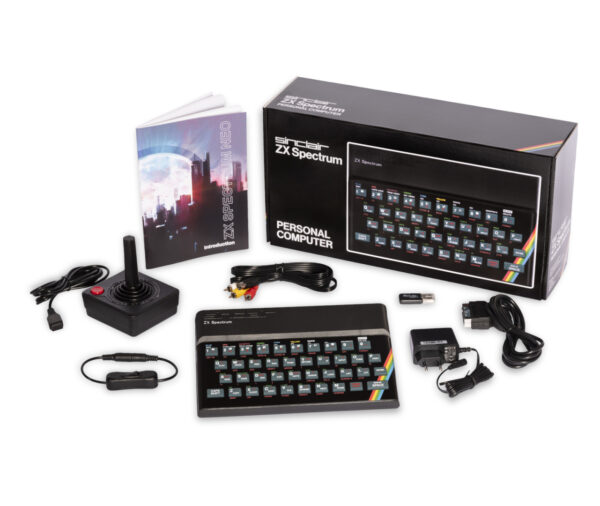
It arrives as a finished computer rather than a project. Case, rubber keyboard, joystick, both video leads, power supply with a switch, a printed manual and an SD card with the operating system and a few demos already on it. Connect it to a television, press the switch, and the cursor is flashing in under a second. Nothing on the outside gives away that it was not made in the early 1980s.
Getting programs into it
There are three ways in, and most people end up using all three.
The card. Games and programs live on an SD card as ordinary files, and the slot is tucked into the side of the case where nothing shows. A card reader is in the box, so you can copy files across from a PC and put the card back. From there you pick what to run in the file browser.
Tape, or what now stands in for it. TAPE IN and TAPE OUT sit on the back on jack sockets. A double-ended stereo mini-jack lead will connect a cassette recorder if you want the whole ceremony, and it will just as happily connect a phone running an app such as ZX Tape Player, which turns a downloaded file back into the same pips and screeches and plays them down the wire. You type LOAD “” and wait, exactly as you did then.
Bluetooth. A Bluetooth card is built in, so the phone does not even need the lead. The sound arrives over the air from a large cloud library of titles and the computer hears it as tape. There is no USB loading, and there was never meant to be.
esxDOS — a filing system on a Spectrum
The card is not just storage. esxDOS is mass storage, a disc operating system and a file system together, and it changes how the machine feels to use. Programs in TAP, SNA, Z80, TRD and BASIC formats — the formats the online archives are full of — are copied to the card and launched from the file browser without ceremony.
It also reaches back into BASIC. Saving and loading your own programs becomes a normal, quick thing to do, and the command set is extended with DOT-Commands, so the utilities you install behave like new keywords rather than separate programs. And it will freeze the entire state of the computer — everything, mid-game or mid-experiment — and put it back later exactly as it was. Anyone who spent an evening in 1985 not daring to switch off will understand what that is worth.
On the screen, and out of the speaker
Picture and sound come out on a MiniDIN video socket, and both leads are in the box: RGB over SCART for the sharpest picture the machine can give, and composite over RCA for televisions and monitors that only take that. Stereo audio travels with the picture on either lead. For an HDMI television you add a SCART-to-HDMI converter between the two. There is a separate STEREO SOUND jack as well, carrying the AY audio on its own, for when you would rather it went to speakers than to the telly.
Two things here the 1980s machines never had: ULAplus, a richer colour palette that newer games and modern conversions make use of, and the option to run the processor at 7 MHz instead of the original 3.5 MHz when you want the extra speed.
Which Spectrum it is this evening
512 kB of ROM holds several computers at once, switchable from a menu: ZX Spectrum 48, 48+, 128, +3e and Pentagon, plus ZX80 and ZX81, plus two diagnostic programs for when something needs looking at. A MAGIC button on the case brings up the hardware configuration menu, and a RESET button does what it says. Behind all of it sits 512 kB of RAM.
What you can actually learn on it
This is the part that matters to us more than the games. Under the rubber, a Spectrum is a processor, memory, BASIC in ROM and a bus brought out to the back — and you can hold the whole of it in your head, which is not true of anything on your desk now.
The ZX EDGE CONNECTOR is the real one, the same edge the period peripherals and memory expansions plug into. From BASIC you drive whatever is on that bus with OUT and IN: one line, ENTER, and a relay clicks. Nothing to install, nothing to compile, no toolchain to keep alive. Wire up a sensor, read it from a BASIC line, watch the number change on a television — it remains one of the clearest ways anyone has found to teach what a port and a bus really are.
Inside the case there is more for people who open things: eight GPIO ports, a serial port at RS-232 with TTL signal levels, a place to connect a PS/2 keyboard, a place for a WiFi module, and headers for an extra sound card and for VGA and HDMI connectors. And when BASIC starts to feel slow, the Z80 underneath is a real Z80: the same assembler, the same instruction timings, the same contended memory that the demo scene spent decades learning to exploit. Code written against those quirks runs here as its authors intended, because the quirks are present rather than approximated.
What is in the box
- computer in a ZX Spectrum 48 replica case (rubber-key model)
- user manual — 52 pages, in English
- Kempston standard joystick with microswitches
- TV lead with SCART / Euroconnector (RGB video and stereo audio)
- TV lead with RCA connector (composite video, stereo audio)
- power supply with switch
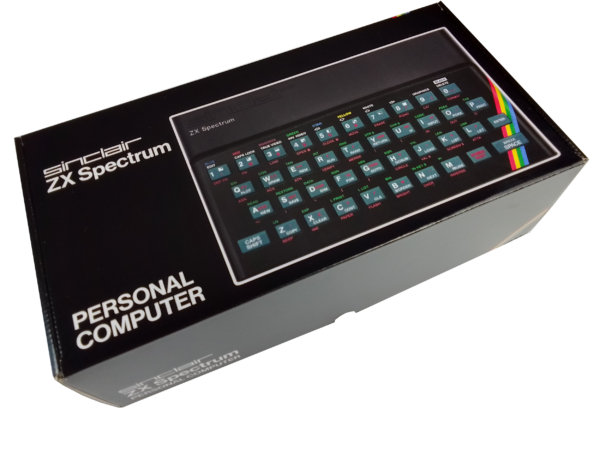
- box modelled on the original ZX Spectrum 48 packaging
- SD card with the esxDOS operating system and demos
- SD card reader, for copying games and programs across from a PC
- built-in Bluetooth card
Technical specification
- 512 kB RAM
- 512 kB ROM with switchable computer images: ZX Spectrum 48 / 48+ / 128 / +3e / Pentagon, plus ZX80 and ZX81 and two diagnostic programs
- real, non-emulated Z80 processor
- real, non-emulated AY-3-8910 sound chip
- ZX EDGE CONNECTOR, for ZX Spectrum peripherals and memory
- STEREO SOUND jack — AY audio
- TAPE IN / OUT jack — tape operations
- VIDEO jack — composite, RGB video and stereo audio
What it has that a 1980s ZX Spectrum 128 did not
- RGB and composite video with audio on a MiniDIN socket, where the original had only an RF television output
- RESET button
- MAGIC button, which opens the hardware configuration menu
- joystick port to Kempston or Sinclair standard
- SD card support with the esxDOS operating system
- Bluetooth, for sending programs from a smartphone out of cloud archives
- processor clock raisable to 7 MHz, against the original 3.5 MHz
- ULAplus, a richer colour palette used by some newer games and modern conversions
Inside the case, for the electronics-minded
- connection point for a WiFi module
- connection point for a PS/2 keyboard
- serial port (RS-232) at TTL signal levels
- 8 GPIO ports
- room to add a sound card
- room to add VGA and HDMI connectors
Questions people ask
Is this an emulator?
No. There is a real Z80 processor and a real AY-3-8910 sound chip on the board, and the rest of the machine is built in hardware around them. Nothing is making an educated guess about what a Spectrum would have done, which is why demos that depend on exact hardware timing run here properly rather than nearly.
Will it run original games?
Yes. Programs in TAP, SNA, Z80, TRD and BASIC formats go on the SD card and launch from the esxDOS file browser. You can also load the old way, as audio, from a cassette recorder or from a phone app over a mini-jack lead or over Bluetooth — the machine cannot tell the difference, because to it there is none.
How is it different from machines that emulate a Spectrum in software?
An emulator reproduces the behaviour a program expects; this reproduces the machine that produced the behaviour. In practice the difference shows up at the edges — in demos and in code written to exploit the ULA’s timing and the way contended memory stalls the processor. There is no compatibility mode here, because there was nothing to be compatible with.
Can I connect original ZX Spectrum peripherals?
The ZX EDGE CONNECTOR is the genuine article and is there for period peripherals and memory expansions. One piece of workshop advice, which applies equally to a machine from 1983: switch the computer off before you plug anything into that edge, and off again before you pull it out. Plugging into a live edge connector is one of the more reliable ways to end an evening early.
Can I connect it to a modern television?
Yes. Sets with a SCART socket take the RGB lead, which gives the better picture; sets with RCA inputs take the composite lead. Both leads are in the box. For an HDMI-only television you put a SCART-to-HDMI converter between the computer and the set.
Which case finishes are made?
Two: matt black, and smoked translucent. [DO UZUPELNIENIA: jak klient wybiera wykonczenie obudowy przy zamowieniu — produkt 6218 nie ma wariantow]
The parts, old and new
Most of what is on this board was bought new. The memory is contemporary, and so is nearly everything around it — parts from current production rather than silicon lifted off a donor board. Those are the more predictable parts, and not because the originals were badly made: a part bought new has a short, documented history, while a chip pulled out of a donor has forty years of history that nobody wrote down.
Two devices we did not modernise, out of respect for what this machine descends from — the processor and the AY sound chip. The processor is a Zilog Z84C00 — Zilog’s CMOS Z80, still in production today, and the Z80 named everywhere else on this site: same instruction set, same pinout. It is a current part rather than one recovered from a donor, and that is rather the point. The device and the package are the ones a Spectrum used; the particular chip doing the work left the factory recently, which is why we trust it. Both sit in dual-in-line packages of the original kind: two rows of legs, the outline anyone who has had the lid off a Spectrum knows on sight.
And not everything in here is a chip of that era — we would rather say it than let you assume otherwise. The ULA logic is not an original ULA: it is re-implemented in an Altera EPM1270 CPLD, a current part doing that job in hardware. The processor and the AY are physical devices doing their own work, not software standing in for them. Everything else on the board is from current production. Those two are the same processor and the same sound chip a Spectrum used, in the same kind of package.
Platform credit. The Sizif-512 platform was designed by Eugene Lozovoy, known in the ZX community as UzixLS, and is published as open hardware under the MIT licence at github.com/UzixLS/zx-sizif-512 — © 2020 Eugene Lozovoy. MUMIO builds on that design and is not affiliated with the Sizif-512 project.
Reviews
There are no reviews yet.