
EVERY COUNTRY
GOT ITS OWN.

MATTERS
An emulator makes an educated guess about what the hardware would have done. Close enough for most games. Nowhere near close enough for a demo.
The scene spent decades learning to exploit the exact timing of the ULA, the way contended memory stalls the processor, the moment the border interrupt fires — every flaw Sinclair shipped by accident and never fixed.
Demos that stutter on The Retro, or on a software emulator, run here as their authors intended. We added no compatibility mode. There was nothing to add.
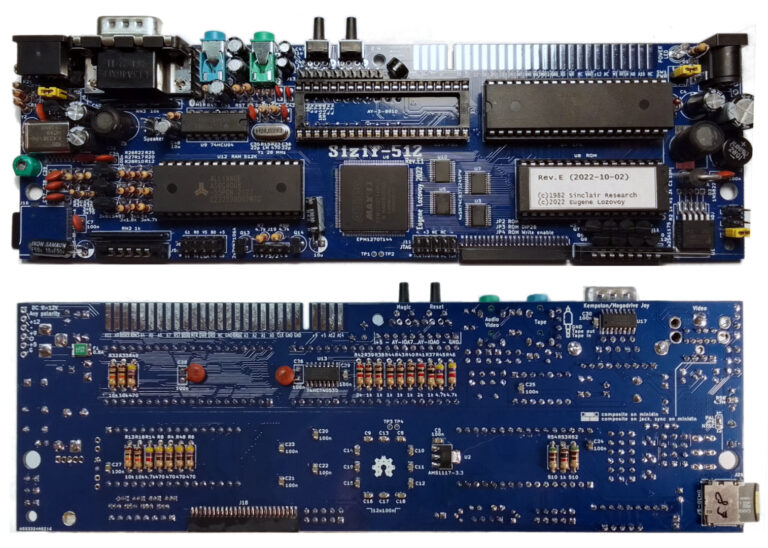
The board is built from parts in current production, not from silicon lifted off a donor: a component bought new has a short, documented history, and one pulled off a board built in the eighties has a history nobody wrote down. Two we did not modernise, out of respect for what this machine descends from — the processor, a current-production Zilog Z84C00 — Zilog’s CMOS Z80 — and the AY, both in dual-in-line packages of the original kind. The ULA logic is a modern part doing an old job: a CPLD, not an original ULA.
THE TAPE DOESN’T.
Games still load as audio — that awful, wonderful noise is genuinely how the machine reads a program. Use a lead from anything that plays sound, a cassette deck included, if you fancy the full ceremony.
Or send the game from your phone: an app turns the code back into those same pips and squeaks and transmits them over Bluetooth, from a cloud library of several thousand titles. esxDOS handles the files, and a microSD sits hidden in the side of the case.
There is no USB loading. There was never meant to be.
Posted worldwide.
NOTHING
SHOWS.
Photographed on the bench where they are built, not in a studio.


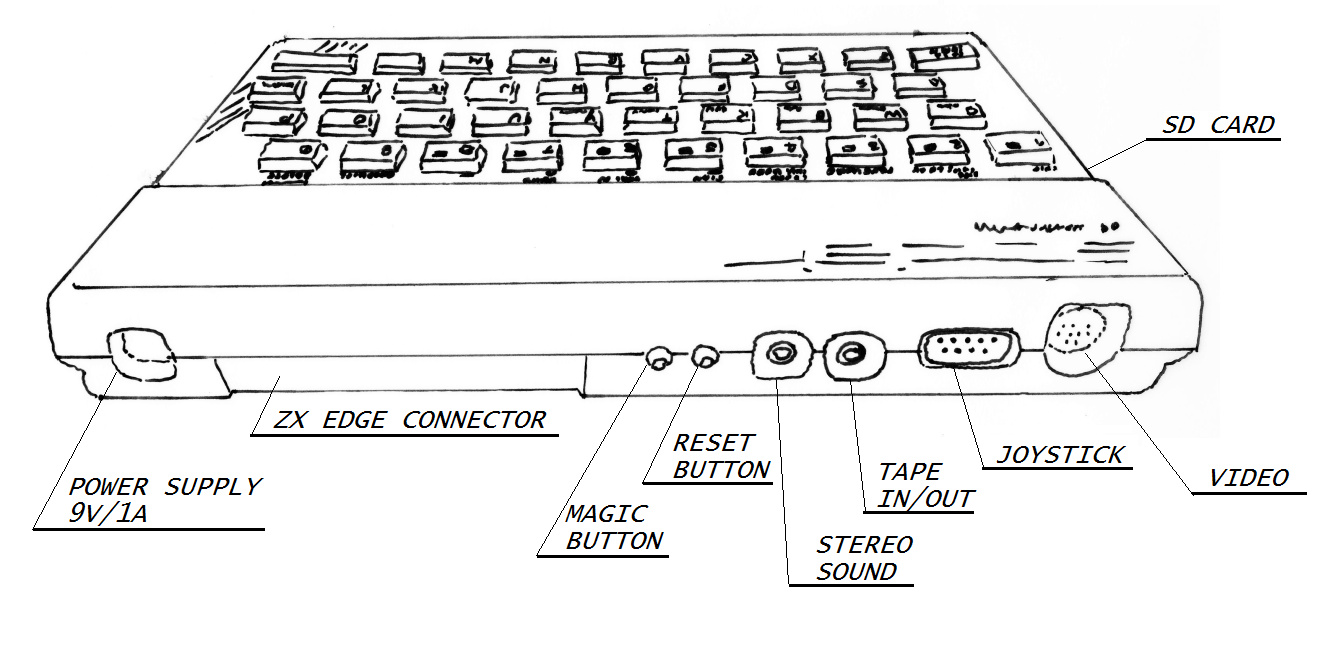
SIGNED OFF BY A PERSON.
Surface-mount parts are placed on our own machines, here in Poland. That is not romantic, but it is why two boards from the same batch behave identically — a placement head does not get tired at four in the afternoon.
Everything through-hole — the sockets, the connectors, the parts that take mechanical punishment — goes in by hand afterwards. Those are the joints that decide whether a machine survives forty years of being plugged and unplugged.
Every board is soaked in a burn-in test and then checked by a person, not by a rig left running overnight. Nothing leaves here that has not been run hot, verified and fitted properly into its case.
What bedroom programmers achieved inside those limits is still, four decades later, difficult to believe. These are the machines they wrote it on.


A Spectrum game can be finished in an hour, which people mistake for a shortcoming. It takes many hours of practice, stubbornness and swearing to reach the point where an hour is enough. That was always the deal.
Filmed in Polish — English subtitles are switched on automatically. If they do not appear, the CC button in the player turns them on.
MUMIO began as something else: peripherals for the ZX Spectrum, built along the lines of Arduino shields. Sensors, displays, motors, servos, relays, clocks, joystick interfaces — on an addressable I/O card in the edge connector, up to 256 chained together.
Under the rubber the Spectrum is an eight-bit processor, forty-eight kilobytes, BASIC built in and a bus brought out to the back. Not far off a modern microcontroller board — with one advantage nobody took back. You drive it all from BASIC using OUT and IN. One line, ENTER, the relay clicks. Nothing to install, nothing to compile.
It turns out to be a rather good way to teach the subject: wire up a real sensor, read it from BASIC, watch the number change on a television.
The range is off sale while we rework it. Plugging cards into a live edge connector is one of the more reliable ways to kill a vintage machine, and the redesign is largely about making that safe. We are doing it with people who know this platform down to the silicon.
Fifty-two pages, printed on paper, in the third edition. Not a QR code pointing at a PDF that will rot in four years — a book you can leave open next to the keyboard while you type.
There is a PDF as well, for the people who prefer it. We simply do not think that should be the only option.

Case — matt black or smoked translucent
Rubber keyboard, as it always was
RGB SCART and composite out
Power switch. Reset button.
AY-3-8910 · three channels
microSD with esxDOS, hidden at the side
Bluetooth audio loading
Boots in under a second
QTY @ €287 each
Personalised boxes, manuals and cases.